Forecasting quick start#
This notebook uses ERA5 data and a pretrained NeuralGCM model to make a
weather forecast with neuralgcm-torch, the idiomatic-PyTorch
rewrite of NeuralGCM (plain nn.Modules; no JAX, gin or haiku at runtime).
The forecast is made in 3 steps:
A slice of ERA5 data is regridded to model resolution
The NeuralGCM model state is initialized and rolled out
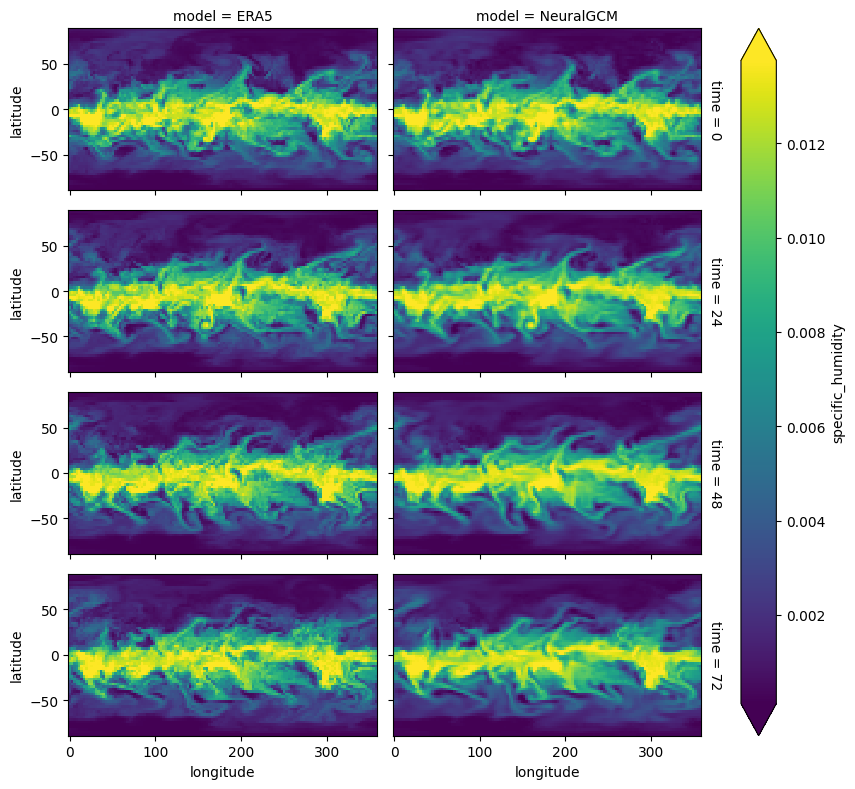
Predictions and reference trajectory are combined for visualization
This mirrors the upstream inference_demo notebook. It needs network access for the model checkpoint and the ERA5 data (both anonymous GCS); a CUDA GPU is recommended but not required.
import pathlib

import numpy as np
import torch
import xarray

from dinosaur_torch import horizontal_interpolation
from dinosaur_torch import xarray_utils
import neuralgcm_torch as neuralgcm

device = 'cuda' if torch.cuda.is_available() else 'cpu'
Load a pre-trained NeuralGCM model#
By default, this notebook uses the 2.8° deterministic NeuralGCM model.
neuralgcm-torch runs converted checkpoints: the original NeuralGCM
gin-config + haiku-parameter pickles were translated once, offline, into
plain torch.save files (see neuralgcm_torch.checkpoint for the
format). The cell below fetches one with pretrained.fetch_checkpoint —
downloaded from the Hugging Face Hub on first use and cached, or read from
a local checkpoints/ directory if present.
Other available checkpoints include deterministic 0.7°, 1.4° and stochastic 1.4° NeuralGCM variations. All models are licensed under CC BY-SA 4.0.
model_name = 'deterministic_2_8_deg'  #@param ['deterministic_0_7_deg', 'deterministic_1_4_deg', 'deterministic_2_8_deg', 'stochastic_1_4_deg']

from neuralgcm_torch import pretrained
# Fetched from the Hugging Face Hub on first use (cached), or reused from
# a local checkpoints/ directory if present.
converted_path = pretrained.fetch_checkpoint(model_name, local_root='checkpoints')
model = neuralgcm.PressureLevelModel.from_checkpoint(converted_path, device=device)
Load ERA5 data from GCP/Zarr#
Select out a few days of data from ERA5:
era5_path = 'gs://gcp-public-data-arco-era5/ar/full_37-1h-0p25deg-chunk-1.zarr-v3'
full_era5 = xarray.open_zarr(
    era5_path, chunks=None, storage_options=dict(token='anon')
)

demo_start_time = '2020-02-14'
demo_end_time = '2020-02-18'
data_inner_steps = 24  # process every 24th hour

sliced_era5 = (
    full_era5
    [model.input_variables + model.forcing_variables]
    .pipe(
        xarray_utils.selective_temporal_shift,
        variables=model.forcing_variables,
        time_shift='24 hours',
    )
    .sel(time=slice(demo_start_time, demo_end_time, data_inner_steps))
    .compute()
)
Regrid to NeuralGCM’s native resolution:
era5_grid = xarray_utils.grid_spec_from_dataset(full_era5)
regridder = horizontal_interpolation.ConservativeRegridder(
    era5_grid, model.data_grid, skipna=True, device=device
)
eval_era5 = xarray_utils.regrid_horizontal(sliced_era5, regridder)
eval_era5 = xarray_utils.fill_nan_with_nearest(eval_era5)
Make the forecast#
inner_steps = 24  # save model outputs once every 24 hours
outer_steps = 4 * 24 // inner_steps  # total of 4 days
timedelta = np.timedelta64(1, 'h') * inner_steps
times = np.arange(outer_steps) * inner_steps  # time axis in hours

# initialize model state
inputs = model.inputs_from_xarray(eval_era5.isel(time=0))
input_forcings = model.forcings_from_xarray(eval_era5.isel(time=0))
initial_state = model.encode(inputs, input_forcings, rng=42)

# use persistence for forcing variables (SST and sea ice cover)
all_forcings = model.forcings_from_xarray(eval_era5.head(time=1))

# make forecast
final_state, predictions = model.unroll(
    initial_state,
    all_forcings,
    steps=outer_steps,
    timedelta=timedelta,
    start_with_input=True,
)
predictions_ds = model.data_to_xarray(predictions, times=times)
For longer rollouts, model.compile(initial_state, all_forcings) wraps the
advance step with torch.compile first (a one-time cost of a few minutes
that makes each simulated day several times faster).
Compare forecast to ERA5#
See WeatherBench2 for more comprehensive evaluations and archived NeuralGCM forecasts.
# Selecting ERA5 targets from exactly the same time slice
target_trajectory = model.inputs_from_xarray(
    eval_era5
    .thin(time=(inner_steps // data_inner_steps))
    .isel(time=slice(outer_steps))
)
target_data_ds = model.data_to_xarray(target_trajectory, times=times)

combined_ds = xarray.concat([target_data_ds, predictions_ds], 'model')
combined_ds.coords['model'] = ['ERA5', 'NeuralGCM']
# Visualize ERA5 vs NeuralGCM trajectories
combined_ds.specific_humidity.sel(level=850).plot(
    x='longitude', y='latitude', row='time', col='model', robust=True, aspect=2, size=2
);